

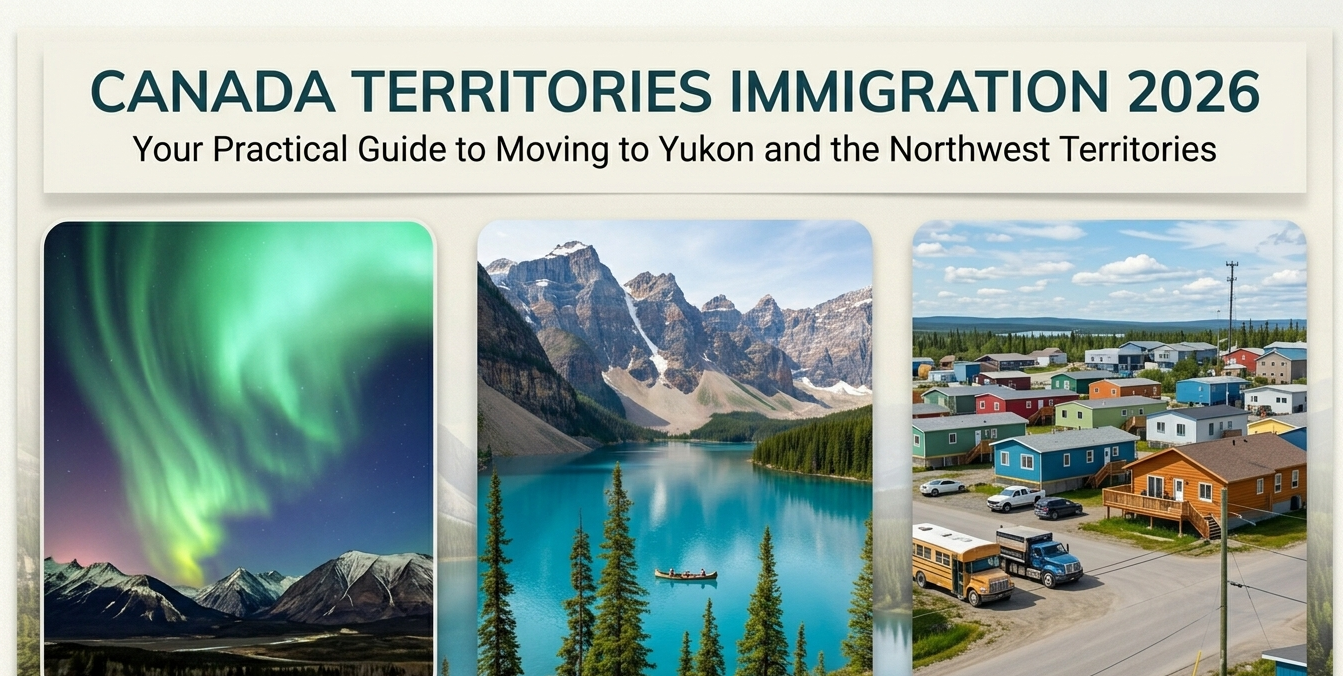

The Part of Canada That Most Immigration Guides Forget
People planning to move to Canada almost always start with the same shortlist. Ontario, BC, maybe Alberta or Manitoba. That is perfectly reasonable. Those provinces are large, well-known, and have strong economies. But there are two places at the top of the country that quietly offer something quite different: a shorter queue, a stronger chance of getting picked, and a lifestyle that a lot of people end up loving far more than they expected.
Yukon and the Northwest Territories are not for everyone. Let us be honest about that upfront. The winters are genuinely cold, some communities are remote, and services can be fewer than in the south. But for the right person, with the right job, these territories offer one of the most direct and accessible paths to Canadian permanent residence available in 2026.
And here is the fact that most people miss: because the pools are smaller, your individual chances are significantly better. There are not tens of thousands of people competing for the same spots as there are in Ontario or BC. If you qualify and your employer is on board, the path from application to nomination can move more quickly than almost anywhere else in the country. Let us walk you through exactly how it works in 2026. If you want a quick eligibility check first, the team at KGraph Immigration can review your profile and give you honest advice on whether the territories are a realistic option for you.
One Important Thing to Understand Before You Apply
Both Yukon and the Northwest Territories run employer-driven immigration programs. This means the employer, not you, initiates the process in most cases. The employer spots a labour gap, cannot find a Canadian or permanent resident to fill it, and then applies to the territory to nominate the international worker they want to hire.
That is different from provinces like Alberta or Saskatchewan, where you can submit your own Expression of Interest independently. In the territories, if you do not have a supporting employer, you generally cannot apply. This is not a flaw in the system. It is by design. The territories have small populations and small labour markets, and they want to make sure every nomination goes to a worker who is genuinely needed and genuinely committed to staying.
So if you are thinking about the territories, your first step is to find a Yukon or NWT employer who wants to hire you and is willing to go through the program. Use the KGraph NOC code tool to identify which stream your occupation falls under, then start your job search with that information in hand.
Yukon: What the 2026 Program Actually Looks Like
The Yukon Nominee Program (YNP) is confirmed at 282 nominations for 2026. That is confirmed on the official 2026 YNP process page at yukon.ca. It is smaller than the 357 figure in earlier federal estimates because IRCC confirmed the final allocation at 282. This is an employer-driven program, and the way it works in 2026 is slightly different from what happened in previous years.
Here is what is new: in 2026, Yukon moved to an Expression of Interest system. Employers submit an EOI during one of two specific intake windows, and the government invites the highest-scoring employers to apply. The two EOI windows for 2026 are January 19 to 30 and July 6 to 17.
The January 2026 window has already closed. If you and your Yukon employer missed it, the next opportunity is the July 6 to 17, 2026 intake. Plan ahead. EOIs submitted in 2025 do not carry over. You must submit a fresh one for 2026.
Yukon's Four Program Streams in 2026
The YNP main page lists four streams. Here is what each one means:
- Skilled Worker Stream: This is for TEER 0, 1, 2, and 3 occupations. Your employer must advertise the role within Canada for at least four weeks before applying to confirm there are no qualified Canadians available. The employer pays for your air travel to Yukon and provides health insurance coverage until you qualify for the territorial plan. Both the employer and nominee must sign a Tri-Partite Agreement (TPA) with the Government of Yukon after approval.
- Critical Impact Worker Stream: This is specifically for TEER 4 and 5 occupations, meaning semi-skilled and entry-level roles. Food service workers, retail workers, accommodation staff, and similar roles. This is one of the very few permanent residence pathways in all of Canada that consistently includes TEER 4 and 5 workers, which makes it genuinely special. The same four-week advertising requirement and TPA process applies.
- Yukon Express Entry Stream: For employers who want to hire a worker who is already in the federal Express Entry pool. The worker must meet the requirements for at least one of the three federal Express Entry programs. If nominated through this stream, the worker's CRS score jumps by 600 points, virtually guaranteeing a federal Invitation to Apply for permanent residence. CLB 7 is required for TEER 0 and 1 positions. Details are on the official Yukon Express Entry stream page.
- Yukon Business Nominee Program: For experienced entrepreneurs who want to start a business in Yukon. This has its own separate eligibility process and assessment points grid. Details are available on the Yukon immigration main page.
What Yukon Priorities Look Like in 2026
Because Yukon uses a points-based EOI ranking for employers, knowing the 2026 priorities helps you understand which employer-worker combinations are most likely to be selected. Yukon's priorities include roles in healthcare, skilled trades, information technology, and early childhood education. Workers already living in Yukon, particularly those who received a Temporary Measure Letter of Support in 2024 or 2025, are given priority processing and may not need to submit an EOI at all.
After Your Employer Is Approved: What Happens Next
Once your employer receives an Invitation to Apply from the YNP, here is what happens, as confirmed on the YNP process page:
- Your employer downloads the 2026 application form and completes the employer sections. You complete the foreign national sections. Both parties gather all required supporting documents.
- The completed application is submitted in person at 303 Alexander Street, Whitehorse, or by mail. Walk-in and mailed applications are both accepted.
- Yukon reviews the application. If approved, both you and your employer sign the Tri-Partite Agreement. The employer pays a compliance fee.
- You must apply to IRCC for permanent residence within six months of signing the TPA. You work for your employer under a temporary work permit while your PR is being processed.
- IRCC assesses your admissibility, health, security, and criminality, and makes the final decision on permanent residence.
One detail worth noting: if you are currently in Canada on maintained status (like an extension of a PGWP or a working holiday visa that has technically expired but you have applied to extend), you may not be eligible. You need to maintain valid legal status throughout the entire process.
Northwest Territories: A Program That Just Got Smarter
The Northwest Territories Nominee Program (NTNP) received a confirmed allocation of 197 nominations for 2026, confirmed in the official GNWT announcement at gov.nt.ca. That is lower than 249 as earlier projected. But the bigger story in 2026 is not the number. It is the change in how the program works.
On February 18, 2026, the GNWT formally launched a new Expression of Interest system for its Employer-Driven Stream. This is a significant upgrade. Previously, the NWT used a first-come, first-served system that favoured whoever submitted first rather than whoever was the best fit. The new EOI model changes that entirely. According to the official NWT program news, the government plans to conduct several EOI draws throughout 2026, with the first one on March 25, 2026, selecting up to 65 eligible applicants.
This is genuinely good news for applicants. A more transparent, merit-based system means the people who genuinely fit the NWT's needs have a better chance of being selected, regardless of whether they happened to apply on the first day the intake opened.
NWT Nominee Program Streams in 2026
The full NWT Nominee Program structure is at immigratenwt.ca. There are three streams:
- Employer-Driven Stream: This is the main stream and the one now using the new EOI system. Your NWT employer must register, create an online account, and submit an EOI on your behalf. The EOI includes information about both the employer and the foreign worker. After the draw, selected employers are invited to submit a full application. Full details are on the Employer-Driven Stream page.
- Francophone Stream: For French-speaking workers who want to contribute to the NWT's Francophone communities. This stream remains open on a first-come, first-served basis in 2026 and is not oversubscribed, which means eligible French speakers can apply at any time without waiting for an EOI draw.
- Business Stream: For experienced entrepreneurs and investors who want to start or buy a business in the Northwest Territories and create employment. Also remains on a first-come, first-served basis.
One important thing the NWT is firm about: most applicants have already been living and working in the NWT for a year or more before applying. The program is designed to support retention, not just initial recruitment. If you are currently in the NWT on a valid work permit and your employer wants to keep you, you are in the strongest position.
For the most current program guidance and any mid-year updates, bookmark the NWT Nominee Program newsroom at immigratenwt.ca and the NWT Education, Culture and Employment immigration page.
What Both Territories Need Most: In-Demand Occupations
Based on 2026 program priorities from yukon.ca and immigratenwt.ca, here are the occupations with the strongest prospects in both territories. Confirm your occupation's TEER level and NOC code using the KGraph NOC code tool:
- Healthcare (both territories): Registered nurses, licensed practical nurses, physicians, personal support workers, physiotherapists, pharmacists, and mental health workers. This is the single biggest need across both Yukon and the NWT. Healthcare workers with a valid territorial job offer are consistently among the most prioritised applicants.
- Skilled Trades (both territories): Electricians, plumbers, carpenters, welders, construction equipment operators, and HVAC technicians. Infrastructure projects are ongoing across both territories and tradespeople are needed year-round.
- Information Technology (both territories): Network administrators, IT support specialists, database managers, and cybersecurity professionals. Government and private sector IT needs are growing steadily in Whitehorse and Yellowknife.
- Early Childhood Education (Yukon priority): Licensed early childhood educators and daycare workers are specifically called out in Yukon's 2026 priorities. Whitehorse has significant demand in this sector.
- Mining and Resources (NWT focus): The NWT's diamond, gold, and lithium mining industries require engineers, geologists, mine supervisors, and equipment operators. Mining drives a significant portion of the NWT's economy.
- Hospitality and Service (Yukon Critical Impact stream): Food service workers, hotel and accommodation staff, and retail workers. Only available through Yukon's Critical Impact Worker stream and one of the few PR pathways in Canada open to TEER 4 and 5 workers.
Documents You and Your Employer Will Need
Because these are employer-driven programs, both you and your employer have document responsibilities. The official checklist is included in the YNP application form available at yukon.ca and on the NWT Nominee Program website. Here is the general core list:
For the employer:
- Proof that the job was advertised within Canada for at least four weeks (job postings, screenshots, or confirmation from a job board)
- Records showing that no qualified Canadian or permanent resident applied or was available for the role
- A valid business registration and proof of the capacity to pay the offered wage
- A formal written job offer confirming the role is full-time, permanent, and year-round
- For you, the foreign worker:
- Valid passport with at least 12 months remaining validity
- Language test results from a designated testing organisation, less than two years old at the time of application
- Educational credentials and, if studied outside Canada, an Educational Credential Assessment from a recognised body
- Employment reference letters confirming your work experience in the relevant occupation
- If applying through Express Entry: your federal Express Entry profile number and Job Seeker Validation Code
- For the NWT Employer-Driven Stream: a completed Expression of Interest submitted by your employer during an active intake period
Incomplete applications are returned unprocessed in both programs, with no refund. Preparing everything in advance with the help of an immigration consultant can save significant time and money. KGraph's application support team specialises in territorial and provincial PNP applications and can help you and your employer build a complete, accurate package.
What Life in the Territories Is Really Like
This is the part of most immigration guides where the writer talks about the Northern Lights and moves on. That is not enough. You deserve a more honest picture if you are genuinely considering this move.
Yukon's Whitehorse is a proper city, with around 30,000 people. It has supermarkets, coffee shops, restaurants, gyms, a university college, and a growing arts scene. There is a real Filipino community, a growing South Asian community, and a strong multicultural atmosphere that has been building for years. The summers are genuinely beautiful, with long daylight hours and warm temperatures. The winters are cold, but not as extreme as many people expect. Whitehorse sits in a mountain valley that protects it from the worst Arctic air.
Yellowknife in the NWT is slightly larger, at around 20,000 people. It has a more frontier feeling, but it is also a full service city with a hospital, government buildings, schools, and an active social life. The Northern Lights are extraordinary from Yellowknife, some of the best aurora viewing in the world, and the city has built a small but real tourism economy around that. Winters are more severe than Whitehorse, with temperatures that can drop below minus 40 Celsius in January.
The honest truth is that both places suit people who are comfortable with space, with natural beauty as part of daily life, and with a smaller community where you will be known. Many immigrants who come for a job end up staying permanently because they find exactly what they were looking for: a safe, affordable, welcoming place to raise a family with a quality of life that money alone cannot buy in a big city.
For more on settling in Canada across different provinces and territories, check the KGraph immigration blog for first-hand guides and settlement advice.
Is a Territory Right for You?
Here is the simplest way to think about it. If you have a job offer from a Yukon or NWT employer in healthcare, skilled trades, technology, or early childhood education, the territories should be on your shortlist. The pools are smaller. The processing can be faster. And the communities, while small, are genuinely welcoming in a way that takes many immigrants by surprise.
If you do not yet have a job offer in the territories, your first priority is to find one. The program does not help you with recruitment and does not maintain a list of employers. That part is on you. But if you do land an offer, the path from there to permanent residence is more straightforward than most people expect.
To get a personalised assessment of whether Yukon or the NWT is the right option for your profile, reach out to the team at KGraph Immigration. Our licensed RCICs have guided clients through territorial programs and know the nuances that make the difference between a successful application and a returned one. Visit our services page or learn about our team to book your consultation.
Start Your Canada's Territories Immigration Journey with KGraph
KGraph Immigration is a licensed, RCIC-regulated Canadian immigration consultancy. Our team reviews your profile, explains your best options clearly, and guides you at every step of the process. We have helped thousands of families across India, the Philippines, and beyond make Canada their home.
Explore your options at www.kgraph.ca or speak with a consultant about PNP and Express Entry services.
Toronto: +1 416 989 7788 | Mississauga: +1 905 516 7920 | Kitchener: +1 226 753 5747 | India: +91 94476 15977
Frequently Asked Questions: Territories Immigration 2026
How many nominations does Yukon have in 2026 and how are they issued?
Yukon has a confirmed allocation of 282 nominations for 2026, as confirmed on the official 2026 YNP process page at yukon.ca/en/yukon-nominee-program. These are issued through an employer-driven EOI system with two intake windows: January 19 to 30 (now closed) and July 6 to 17, 2026. Employers submit EOIs, the government scores them based on 2026 priorities, and the highest-scoring employers receive invitations to submit full applications.
Can I apply to Yukon PNP without a job offer?
No. The Yukon Nominee Program is entirely employer-driven. You cannot submit an EOI or application on your own. Your Yukon employer must initiate the process by submitting the EOI on your behalf during one of the two intake windows. If you do not have a Yukon employer willing to support your application, you cannot use this program. Finding a Yukon employer is your first and most important step.
What is new about the NWT Nominee Program in 2026?
On February 18, 2026, the Northwest Territories formally launched a new Expression of Interest system for its Employer-Driven Stream. Previously the program used a first-come, first-served approach. The new system scores employer-submitted EOIs based on territorial workforce needs and draws the highest-ranking submissions for full applications. The first EOI draw was on March 25, 2026, selecting up to 65 applicants. The Francophone and Business streams continue as before on a first-come, first-served basis.
What occupations are prioritised in Yukon for the 2026 intake?
Yukon's 2026 priorities include healthcare workers, skilled trades professionals, information technology workers, and early childhood educators. Workers in these sectors have a higher chance of their employer's EOI being selected in the ranking process. Employers whose foreign workers fit these priorities score higher in the EOI assessment and are more likely to receive an Invitation to Apply.
What is the Critical Impact Worker stream and who is it for?
The Critical Impact Worker stream is for TEER 4 and 5 occupations, which are entry-level and semi-skilled roles including food service workers, hotel and accommodation staff, and retail workers. It is one of the very few permanent residence pathways in Canada that consistently includes workers in these occupation categories. The same employer-driven EOI process applies: your Yukon employer must submit an EOI during one of the two intake windows, and the government decides who receives an Invitation to Apply based on 2026 priorities.
Can I move to the territories and then later transfer my permanent residence to a southern province?
Once you become a permanent resident of Canada, you have the legal right to live anywhere in the country. There is no legal requirement that forces you to stay in Yukon or the NWT permanently. However, both territories ask you to demonstrate genuine intent to settle when you apply, and signing the Tri-Partite Agreement includes commitments to your employer. Most nominees do stay for several years before making any decision about moving. Leaving immediately after receiving your PR would go against the spirit of the program, and both territories monitor post-nomination retention.
What if my territorial PNP application is returned or refused?
In both Yukon and the NWT, incomplete applications are returned unprocessed with no refund. You would need to resubmit with all required documents. If your application is refused for eligibility reasons, you will need to understand the reason before reapplying. KGraph's refusal and reapplication service at kgraph.ca/service-details/refusal-and-reapplication helps you identify exactly what went wrong and how to build a stronger application when you try again.