


In this article
The difference, plainly
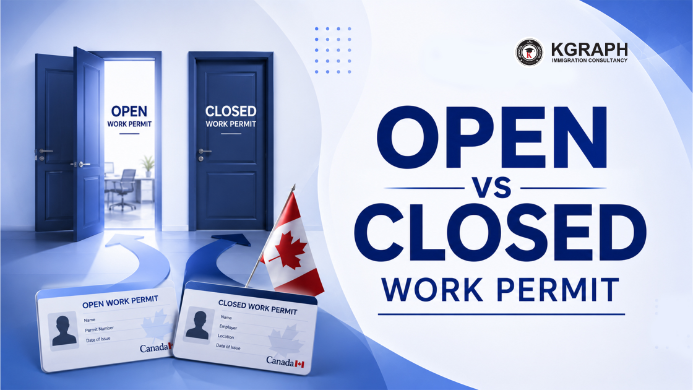
An open work permit lets you work for almost any employer in Canada. It is not tied to a job, a company, a location, or an occupation.
A closed work permit, which IRCC calls an employer specific work permit, names one employer. You can work for that employer, in that job, at that location, and nowhere else. If you leave, you cannot simply take another job. Your permission to work in Canada is attached to the employer who is on the permit.
That single difference changes almost everything about your position in Canada.
Why it matters more than people realise
If you hold a closed permit and your employer treats you badly, you cannot walk out. Leaving means losing your status. Staying means enduring it. That imbalance is not accidental, it is structural, and Canada's own government acknowledges it exists.
If you hold an open permit, you can leave a bad job on a Friday and start a better one on a Monday, like anyone else.
An open work permit is not just more convenient. It is more power.
How to get an open work permit
Open work permits are not something you apply for on general merit. They are attached to specific situations.
The post graduation work permit, for graduates of eligible Canadian programs.
The spousal open work permit, for the spouse or common law partner of certain skilled workers, of certain students, and of people being sponsored for permanent residence.
The bridging open work permit, which lets you keep working while a permanent residence application is being processed.
The International Experience Canada working holiday permit, for citizens of countries with a youth mobility agreement with Canada.
The open work permit for vulnerable workers, which we cover below and which exists precisely because closed permits create the trap described above.
Various open permits attached to permanent residence streams and pilots.
If any of those describe you, an open work permit is very likely the single most valuable document you can obtain.
How closed work permits work
A closed permit is generally supported either by a positive Labour Market Impact Assessment, which the employer obtains from Employment and Social Development Canada, or by an LMIA exemption under the International Mobility Program.
If it is LMIA exempt, the employer still has obligations. In most cases they must pay a two hundred and thirty dollar employer compliance fee and submit an offer of employment through IRCC's Employer Portal, which produces a seven digit number you need for your application.
If it is LMIA based, the employer must pay one thousand dollars per position, advertise the role, meet prevailing wage requirements, and comply with a long list of conditions.
Two things your employer legally cannot do
They cannot charge you the LMIA fee or any recruitment fee. Not directly, not as a deduction, not through a lower wage. If someone is asking you for money to get you an LMIA, walk away.
They cannot treat you abusively and rely on your permit to keep you there. Which brings us to the most important thing on this page.
If you are being abused, you can get out
Canada has an open work permit for vulnerable workers.
It is for workers on employer specific permits who are experiencing abuse, or who are at risk of abuse, in relation to their job in Canada. Its explicit purpose, in IRCC's own words, is to help you leave an abusive situation and find a new job.
Abuse here is not limited to physical violence. It includes psychological abuse, financial abuse, and sexual abuse, and it can include an employer who withholds your pay, takes your passport, threatens to have you deported, or forces you to work in unsafe conditions.
You do not need your employer's permission to apply. You do not need them to know.
You can also report an abusive employer to Employment and Social Development Canada. Employers can be fined between five hundred and one hundred thousand dollars per violation, up to a million dollars in a year, banned from hiring foreign workers for one, two, five or ten years or permanently, and named publicly on IRCC's non compliant employers list. Their existing work permits for workers can be revoked.
The system is not perfect. But it exists, and it is used, and no one should be enduring an abusive employer in silence because they believe leaving means losing everything.
Two restrictions even open permits have
Even with an open work permit, you cannot work for an employer who is on IRCC's non compliant employers list. That list is public. Check it.
And you cannot work for an employer who regularly offers striptease, erotic dance, escort services, or erotic massage.
What to do with this
Find out which permit you have. It says on the document. If it names an employer, it is closed.
If it is closed, find out whether you are eligible for an open permit through any of the routes above, particularly if your spouse is a student or a skilled worker in Canada, or if you graduated from a Canadian institution.
And if you are being mistreated, understand that the law gives you a way out, and that using it is not a risk to your status. It is a protection of it.
Not sure which pathway is right for you? Our RCIC-licensed consultants can advise you on the best strategy based on your immigration goals.
Prepared by Fernando Amaro, KGraph Immigration. Last updated July 2026. General information, not legal advice.
Not sure which pathway is right for you? Our RCIC-licensed consultants can advise you on the best strategy based on your immigration goals.
Check Your EligibilityPrepared by Fernando Amaro, KGraph Immigration Consultants. Last updated July 2026. This guide is for general information purposes only and does not constitute legal or immigration advice.