

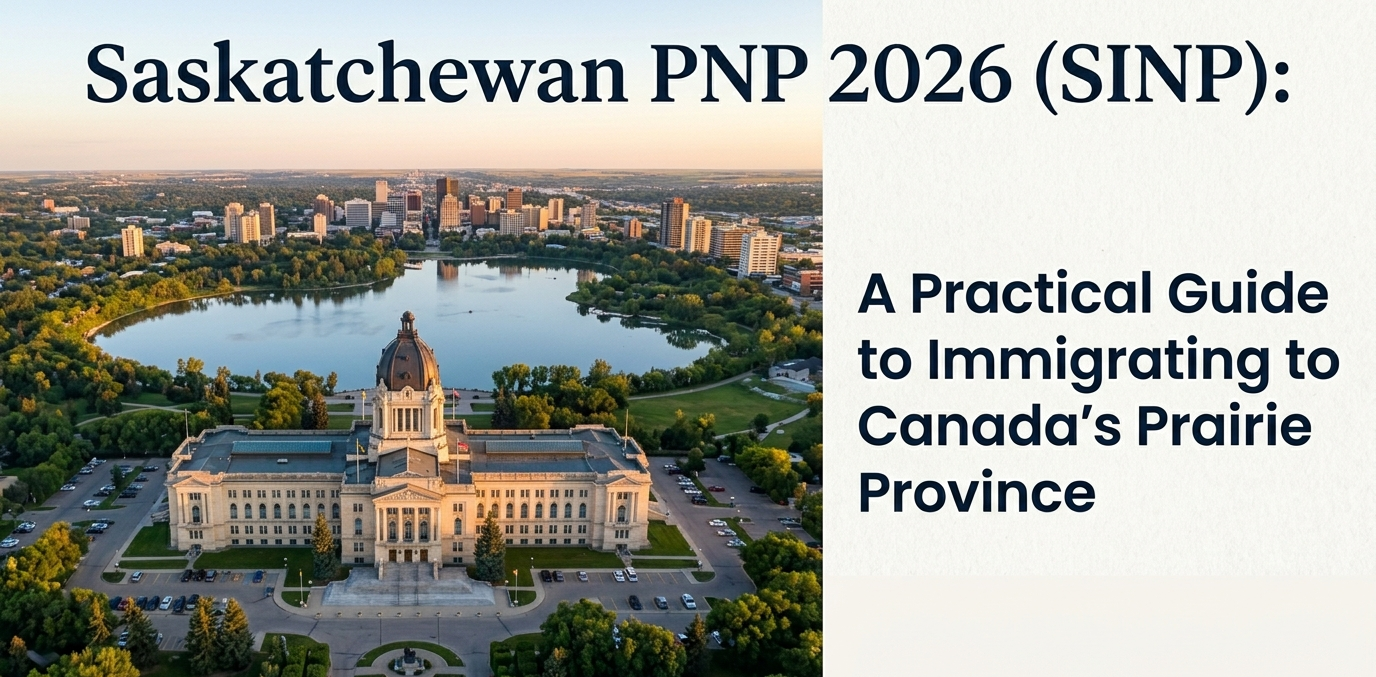

Introduction to Saskatchewan
If someone asked you to point to Saskatchewan on a map, you might hesitate for a second. That is fine. Most people outside Canada are not too familiar with this province. But here is what matters: Saskatchewan is one of the most practical and straightforward immigration options in Canada right now.
It sits in the middle of the country, surrounded by flat farmland, oil fields, and some genuinely beautiful open skies. Saskatoon and Regina are its two main cities. They are not massive, but they are clean, safe, affordable, and growing. The job market in healthcare, agriculture, skilled trades, and technology is strong and getting stronger every year.
The Saskatchewan Immigrant Nominee Program, or SINP, has a confirmed nomination allocation of 4,761 spaces for 2026. That is confirmed directly on the official SINP FAQ page at saskatchewan.ca. Unlike 2025, there are no federal requirements this year specifying that a certain percentage of nominees must come from temporary residents. That opens the door wider for people applying from outside Canada too.
The program is straightforward, well-documented, and honest about its rules. This guide will walk you through everything you need to know, in plain language, with the real official sources linked so you can verify every detail yourself.
Understanding How the SINP Is Structured in 2026
Before we get into individual streams, you need to understand one important thing that is unique to Saskatchewan in 2026. The SINP divides all occupations into three categories, and those categories affect how and when you can apply. This is confirmed on the SINP processing statistics page:
- Priority Sectors: Healthcare, Agriculture, Skilled Trades, Energy, Mining, Manufacturing, and Technology. These sectors have a minimum of 50% of the total 4,761 nomination allocation reserved for them. Applications in these sectors are accepted on a continuous basis throughout the year. There is no intake window. You apply when you are ready.
- Capped Sectors: Trucking, Accommodation, Retail, and Food Service. These four sectors together are limited to 25% of the total allocation. Applications in these sectors are only accepted during six intake windows in 2026: January, March, May, July, September, and November. You must also have six months or less remaining on your work permit at the time of application. Once the cap for a capped sector is reached, no more applications are accepted for that sector that year.
- Other Sectors: Everything that is not a Priority or a Capped sector. These have open intake throughout the year but are not given a reserved allocation percentage.
Why does this matter? Because if you work in healthcare, agriculture, or skilled trades, you have a dedicated portion of the total allocation set aside for you. You do not have to compete with everyone at once. If you work in trucking, retail, or food service, you need to plan your timing carefully around the six intake windows, and you should track progress on the processing statistics page to avoid submitting after the cap is reached.
The Main Pathways into Saskatchewan: Which One Fits You?
Saskatchewan has several ways to apply, depending on your situation. You can check your specific eligibility on the SINP program eligibility page. Here is a plain-language breakdown of the main pathways:
Option A: International Skilled Worker, Occupations In-Demand
This is the path for skilled workers who do not yet live in Saskatchewan or who are in Canada but want to apply based on their skills and experience rather than a current employer. The full details are on the official Occupations In-Demand page.
Here is something important about this pathway that many people miss: you do not always need a Saskatchewan job offer to apply. You can submit an Expression of Interest based on your education, work experience, language score, and a genuine plan to settle in Saskatchewan. However, having a job offer, or having a connection to Saskatchewan like family or previous work experience there, significantly boosts your points score.
To use this pathway, your occupation must appear on the SINP's In-Demand list. The list changes regularly based on labour market conditions. Your application will not move forward if your occupation is not on that list, even if everything else looks good. Always check the list before you submit your EOI.
You also need to meet a minimum points score. That score comes from your language test result, your age, your years of work experience, your education level, and your Saskatchewan connection. The points grid is available on the eligibility assessment page and is worth reviewing carefully before you decide whether to apply.
Option B: Saskatchewan Express Entry
If you already have a profile in the federal Express Entry system, this is your fastest route to Saskatchewan permanent residence. Saskatchewan searches the Express Entry pool and invites candidates whose skills align with provincial needs. Getting a Saskatchewan nomination through this pathway adds 600 points to your federal CRS score, which is enough to essentially guarantee a federal Invitation to Apply for permanent residence.
The key is that you need a connection to Saskatchewan, and the most common one is a valid Saskatchewan job offer. A family member in the province, or previous work or study experience in Saskatchewan, can also count. This pathway is processed faster than the paper-based route and is generally the best option for anyone already in the federal pool.
Option C: Saskatchewan Experience, Including Graduates
This category is for people who are already living and working in Saskatchewan. There are several pathways within it, including dedicated routes for healthcare workers, agricultural workers, tech workers, and students. The full student and graduate pathway details are here.
For students in particular: if you graduated from a Saskatchewan post-secondary institution and you are currently working in Saskatchewan in a related field on a Post-Graduation Work Permit, this is one of the most direct paths to a nomination available anywhere in Canada. And good news: in 2026, a minimum of 750 nominations from the 4,761 total are specifically reserved for graduates of Saskatchewan post-secondary institutions who have job offers in priority sectors. That is a guaranteed slice of the allocation just for this group.
How the SINP Expression of Interest System Actually Works
For the International Skilled Worker pathways, Saskatchewan uses an Expression of Interest (EOI) system. Here is how it works, as described on the official SINP EOI system page:
You submit an EOI online. Saskatchewan assigns your EOI a score based on your points grid result. Your EOI stays active in the system for 12 months. If it expires without being selected, you can submit a new one.
Saskatchewan does not have fixed draw dates. Draws happen based on annual processing targets and employment demands. There is no published schedule. When a draw happens, the highest-scoring candidates receive an Invitation to Apply. If you get one, you have 60 days to submit your complete application.
One important rule: the information you put in your EOI must be accurate at all times. If something changes in your situation, you must cancel your existing EOI and resubmit with updated information. Providing false information, even accidentally, can result in a two-year suspension from the SINP.
You can track sector-specific nomination progress throughout the year on the SINP Processing Statistics page. This page is updated every three months and shows processing times for each sector category.
Occupations Saskatchewan Needs Most in 2026
Based on confirmed priority sector designations from the official SINP FAQ and the processing statistics page, here are the occupation groups that are best positioned in 2026. Use the KGraph NOC code tool to confirm exactly where your occupation sits:
- Healthcare: Registered nurses, licensed practical nurses, personal support workers, physicians, pharmacists, and allied health professionals. Healthcare has a dedicated fast-track pathway for students and a share of the 750 student-reserved nominations.
- Agriculture: General farm workers, nursery and greenhouse workers, food and beverage processing operators, and agricultural equipment technicians. Saskatchewan is one of the world's top grain producers, and agriculture is always in the priority category.
- Skilled Trades: Electricians, plumbers, welders, pipefitters, heavy duty equipment operators, and industrial mechanics. Tradespeople are in demand across the province year-round.
- Technology and Innovation: Software developers, IT analysts, data scientists, network administrators, and life sciences researchers. The tech sector in Saskatoon in particular is growing quickly.
- Energy and Mining: Petroleum engineers, oil and gas well operators, mine supervisors, and geological technicians. Saskatchewan has significant oil, potash, and uranium production.
- Manufacturing: Industrial mechanics, production supervisors, quality control technicians, and equipment operators across the province's growing manufacturing base.
What Documents You Will Need to Apply
Saskatchewan is clear and specific about documents. The SINP application guide is the official source, and missing even one document will result in your application being returned to you without a refund of your application fee. Here is what you will generally need:
- Valid passport for yourself and any accompanying family members, all pages included
- Language test results from IELTS General Training, CELPIP General, TEF Canada, or TCF Canada at a minimum of CLB 4. Test results must be less than two years old at the time of application
- Educational credential documents including degrees, diplomas, and transcripts. If you studied outside Canada, an Educational Credential Assessment from a recognised body like WES is required
- Employment reference letters for all relevant work experience, on official company letterhead, showing job title, main duties, hours per week, salary, and start and end dates
- Proof of settlement funds held in your name for at least three months before application and maintained throughout the immigration process. The amount required depends on your family size
- A settlement plan explaining where you will live in Saskatchewan, how you will find work, and what support you have
- Saskatchewan connection documents if applicable: previous Saskatchewan work or study records, or letters from Saskatchewan contacts
- A valid SINP Job Approval Letter from your Saskatchewan employer, where required for your specific pathway
If you are applying through Express Entry, you also need your profile number and Job Seeker Validation Code from your Express Entry profile. If your documents are from overseas and need review, KGraph's preparation team can help you make sure everything is complete and correctly formatted before you submit.
Step-by-Step Guide to Applying for Saskatchewan PNP in 2026
The full official process is on the how-to-apply page at saskatchewan.ca. Here it is in plain language, step by step:
- Confirm your occupation is on the SINP In-Demand list and identify which sector category it falls into: Priority, Capped, or Other.
- Check whether you qualify and estimate your points score using the SINP eligibility assessment tool at saskatchewan.ca.
- Complete an approved language test and get your results. CLB 4 is the minimum for most pathways. Higher scores earn more points.
- Gather your documents: passport, language results, educational credentials and ECA if applicable, employment reference letters, and proof of funds.
- Submit your Expression of Interest through the SINP's OASIS online system. Your EOI is valid for 12 months. Make sure all information is accurate. Check your score on the SINP EOI system page.
- If your sector requires a Job Approval Letter, your employer must submit their part during an active intake window. For Priority sectors, intake is open year-round.
- Wait for a draw. When Saskatchewan selects your EOI, you receive an email Invitation to Apply. You have 60 days to submit your full application through OASIS.
- Submit your complete application with every required document. Incomplete applications are returned with no refund.
- SINP reviews and processes your application. Processing times by sector are updated regularly on the SINP Processing Statistics page. If approved, you receive your nomination certificate.
- Apply to IRCC for permanent residence. If you applied through Express Entry, your CRS score jumps by 600 points after nomination. If you applied through the base stream, you apply directly to IRCC by paper.
What Living in Saskatchewan Is Like
People who move to Saskatchewan often say the same things. They were surprised by how friendly people are. They were surprised by how affordable life is. And they were surprised by how much they ended up loving it.
Saskatoon and Regina are mid-sized cities. They do not have the energy of Toronto or the scenery of Vancouver, but they have something those cities struggle to offer: a sense of community and a pace of life that is genuinely good for families. Schools are well-funded. Streets are clean. A nice home costs a fraction of what it would cost in Ontario or BC.
The winters are cold and long. Temperatures drop well below minus 20 Celsius regularly from November to March. But Saskatchewan summers are warm, sunny, and beautiful. The sky is enormous. The sunsets are world-class. People here find ways to enjoy every season, and the outdoor life across all four of them is a real draw for those who appreciate open space.
For stories from people who have made the move to Saskatchewan and other parts of Canada, take a look at the KGraph blog. Our team regularly shares practical settlement guides for newcomers.
Our Thoughts on Saskatchewan for 2026
Saskatchewan will not suit everyone. If your specific career requires a major metropolitan job market, or if city life is genuinely important to you, then larger provinces may be the better fit. But if you have skills in healthcare, agriculture, trades, tech, energy, or manufacturing, and you are willing to build your life in a growing, affordable, and welcoming province, Saskatchewan deserves to be at the top of your list.
The program is transparent. The rules are clearly written. The priority sectors have guaranteed allocation. And unlike some other provinces, there is no requirement this year for a certain percentage of nominations to go to people already in Canada, which is significant for applicants still overseas.
To check whether your occupation qualifies and to understand your chances in the SINP points grid, reach out to the team at KGraph Immigration. Our licensed consultants have helped clients across the country navigate the SINP successfully. Visit our services page or learn about our team to get started.
Start Your Saskatchewan Immigration Journey with KGraph
KGraph Immigration is a licensed, RCIC-regulated Canadian immigration consultancy. Our team reviews your profile, explains your best options clearly, and guides you at every step of the process. We have helped thousands of families across India, the Philippines, and beyond make Canada their home.
Explore your options at www.kgraph.ca or speak with a consultant about PNP and Express Entry services.
Toronto: +1 416 989 7788 | Mississauga: +1 905 516 7920 | Kitchener: +1 226 753 5747 | India: +91 94476 15977
Frequently Asked Questions: Saskatchewan PNP 2026
Do I need a job offer to apply to the Saskatchewan PNP?
For the International Skilled Worker Occupations In-Demand pathway, a job offer is not always required. You can submit an EOI based on your skills, experience, education, and language score alone. However, having a Saskatchewan job offer or a connection to Saskatchewan, like family or previous work experience there, earns you extra points on the SINP points grid and significantly improves your chances of being selected in a draw. For the Saskatchewan Experience pathways where you are already working in Saskatchewan, a Job Approval Letter from your employer is required.
What is the difference between Priority Sectors and Capped Sectors?
Priority Sectors are Healthcare, Agriculture, Skilled Trades, Energy, Mining, Manufacturing, and Technology. These have a minimum of 50 per cent of the 2026 allocation reserved for them and accept applications on a continuous basis throughout the year. Capped Sectors are Trucking, Accommodation, Retail, and Food Service. These are limited to 25 per cent of the total allocation and only accept applications during six scheduled intake windows: January, March, May, July, September, and November. This structure is confirmed on the SINP processing statistics page at saskatchewan.ca.
What happened to the Saskatchewan Entrepreneur and Farm Owner stream?
Both the Entrepreneur and the Farm Owner and Operator categories were permanently closed effective March 27, 2025. Applications that were already in the system at that time continue to be processed. No new applications are being accepted for either category. If you were planning to apply through one of these streams, you will need to explore other SINP pathways or other provincial programs. KGraph can help you identify the best available alternative based on your profile.
How does the 750 student reserved allocation work in 2026?
In 2026, the SINP has specifically reserved a minimum of 750 nomination spaces for graduates of Saskatchewan post-secondary Designated Learning Institutions who have job offers in priority sectors. This means if you graduated from a Saskatchewan university or college, have a valid PGWP, and are working in healthcare, agriculture, tech, trades, energy, mining, or manufacturing, you have access to a dedicated pool of spaces that is separate from the general competition.
How long is my EOI valid and what happens if it expires?
Your EOI is valid for 12 months from the date you submitted it. If it expires without being selected in a draw, you can submit a new EOI. If your situation changes at any point during those 12 months, you must cancel your current EOI and resubmit with updated information. You cannot simply edit an active EOI. If you make a mistake or something changes and you do not update, it could be considered misrepresentation, which leads to a two-year ban from the SINP.
What language score do I need for Saskatchewan PNP?
The minimum language requirement is CLB 4 for most pathways. Your test results must be less than two years old at the time you submit your application. A higher CLB score earns you more points on the SINP points grid, so while CLB 4 may be the minimum, aiming for CLB 6 or higher will significantly improve your competitiveness. Accepted tests are IELTS General Training, CELPIP General, TEF Canada, and TCF Canada.
What if my SINP application is refused or returned?
If your application is returned because it was incomplete, you will be asked to reapply. No refund is given. If your application is refused for reasons related to eligibility or misrepresentation, you may face a waiting period before reapplying. Understanding why your application was refused is the most important step. KGraph's refusal and reapplication service at kgraph.ca/service-details/refusal-and-reapplication helps you review the reason, correct the issue, and submit a stronger application when you are ready.